
AI This, AI That

Collective commenting on the oversaturation of AI-related articles has almost reached par with that which the sentiments critique. Traditionally, the twitter-enabled peanut gallery is correct in their determination of peak thinkboism. But, in this case the collective consciousness’ determination of the zeitgeist may be a little preempted and there may be, in fact, an undersaturation of AI-related articles.
In this belief, I decided to join the conversation.
I interpret the AI landscape as having three main dimensions: Replication, Monetization, and Disruption. Each dimensionality has its own flavor and represents an important aspect of not only the tech but the proactive nature of AI, the reactive behavior of the ecosystem, and the evolution of this relationship over time.
Replication
Since AI became ‘the hot new thing,’ there has been a lot of discussion about how defensible any one type of business is in the space. I think, underlying this premise is a predefined notion of what defensibility means. Defensibility is really based on the probability associated with replication. This derivative follows the training, refining, and distributing to reach what I think is an interesting binary between artificial intelligence and that which defends its market leaders.
Training
Training defensibility centers around capital and compute infrastructure and plays an important role at the infrastructure layer of the AI stack. A company must have the resources and partnerships to train these large models. In this context, it makes sense why OpenAI engaged in the Microsoft deal and Google bought DeepMind. Not only do these models cost a lot to run, but adjacency to infrastructure is important in minimizing non-financial costs. The mere financial barrier to entry is what makes it difficult for new entrants to scale at the infrastructure layer, as there are only some partners that can be beneficial on this front and so much capital that is willing to be devoted to the endeavor.
There have been innovations in compute cost and accessibility. Mosaic demonstrated significant cost reductions in running a GPT-3 parameters-equivalent model. Further, GLM-130B (a Hugging Face model) was shown to outperform GPT-3 (175B) and Google's PALM 540B parameter model on 0-shot, 1-shot, and 3-shot, and other benchmarking tests, and it is open-sourced. As objectives become more generalized, though, parameterization is the key component in achieving generalizability – you can get ahead on the margin within a utility layer, but I do not think optimizations are completely viable to solve scaling utility demands. This results in focused, product-layer applications becoming more competitive, but the near frontier of infra innovation partitioned to a select oligopoly.
Refining
Refining the models is where most of the technical defensibility is encapsulated. I think getting bogged down by the nuances of the actual refinement is counterproductive since the ecosystem is still in its early years and there is a lot to be learned. At the core level, refining is defensible from a human and capital perspective. The refiner needs to have the capital to attract the best people to work for them and build a culture that caters to this type of individual. Further, talent is unevenly distributed, making its market highly competitive. In reminiscence, though. I think the technical advantages gained from talent differentials will be a derivative of a different first-order equation to success.
Distributing
A counterintuitive position, I think in a field that is largely defined by its technicality, distribution is, at a fundamental level, more important than development. This is distribution in every sense – distribution of brand, ethos, and presence. People’s engagement with new technology (particularly consumers) is premised on trust and access. For example, Beautiful.AI provides an enhanced slide deck application that adds distinct improvements over Microsoft’s and Google’s current offerings, but the differential does not matter. Beautiful’s vertical is too specific, and the market is too entrenched. Once the equivalent is released by the primes, it will absorb any incentive to engage with another tool. The new companies that win at distribution will be distributing something that is either functionally new or orders of magnitude functionally better. Search is not new, but ChatGPT, in terms of agency, specificity, and accessibility, is an order of magnitude better than Google at many things, as well as a singular brand. On the other hand, MidJourney’s image-generation platform is functionally new, but its newness and brand are not singular. MidJourney, chiefly denoted the highest quality image generation platform, could define itself as the Tiffany’s of the ecosystem, but Walmart makes a much more compelling incipient value proposition.
In building an AI mega-platform, on par with the importance of commanding cutting-edge training and refinement is the gain-of-function research needed to manufacture the mind virus that will distribute the platform across different markets.
Coalescing training, refining, and distributing, I think that at a core level of any AI-enterprise, the most important piece encompassing defensibility is the human’s part in building it. The greatest companies and innovations were more organizational triumphs than technical ones. Mobilizing and motivating the collective intelligence needed to accomplish a prime objective is often more difficult than the goal itself. In a market where the price for both producer and consumer are quite high, building a new ideology sells into an incorporeal nature of humans that inhabit all markets.
Monetization
There have been a lot of capital inflows to the AI space, but few outflows. Simultaneously, the venture ecosystem seems enamored to continue pouring more money into the sector with there being little hysteresis of economic viability. This juxtaposition is not new - uncertainty is a core part of innovation - but the cohesion between thesis-driven certainty and financial insecurity is an omen to inflation.
SaaSification
When monetization models have taken form, they have largely followed the traditional SaaS structure. Although SaaS will remain a vector by which many purpose-driven programs engage with society, I think AI’s marriage to it will be atavistic. Specifically, I think dominant estates will buy up the neighboring land, leading to the orthodox applications of AI being absorbed by the existing aristocracy – the next widely used text editor will be Microsoft Word, the next widely used photo editor will be Abode, etc.
This perspective is not a product of a pessimistic perspective on the new incumbents, but a perception of nothing new at all. Most ‘AI’ companies are not doing anything new. For the most part, the composition of the sector is just productizing LLMs and transmorphing that productization into a different version of existing applications.
Because of this, I think the volume of AI SaaSification will occur not because the model caters to the product, but because the product consumes the model. SaaS is how software’s drawn-out engagement with society was consecrated. A divorce may occur, but I think the run-up to such will be a long-tail productization of Software 2.0, which has only begun.
Economic Adaptation
Beyond SaaS, I don’t know how the exact monetization schematic of AI will be built out. It could be a pull from the cloud pricing models of AWS and Azure, implement an internet tax like Stripe, or draw from another strategy previously employed, but one thing I do think is that it will not be a strategy previously employed. Each prior monetization methodology was a function of its technology, and each form of technology abounded because it engendered a new, valuable use case. In a pure form factor, the use case of AI is different from that of offloading compute, facilitating commerce, or anything else that has come before it, and with that, the next large companies that emerge from it will come up with new creative ways that the economy engages with the use case.
Disruption
The one narrative that I do find myself agreeing with is that AI is going to massively augment human engagement with technology. I do not know the full form that this augmentation will take nor how quickly it will happen, but there are three trends that I think about a lot.
Apriori Absorption
I think more generalized LLM interfaces will absorb a lot of the functionality of current, siloed software applications. Specifically, asymmetric applications that strictly involve a human’s engagement with a machine (not communities, etc.) will see a lot of their former utility made obsolete. Already with ChatGPT, the services of thesaurus.com, dictionary.com, Grammarly, and similar digital entities have been paralleled with limited substitutive productization. More generally, this collection of applications can be represented by a surjective mapping in the set of apriori applications. These are applications where the user knows their engagement with it will result in the answer they are looking for – i.e., when someone uses dictionary.com they know apriori they will receive their desired result.
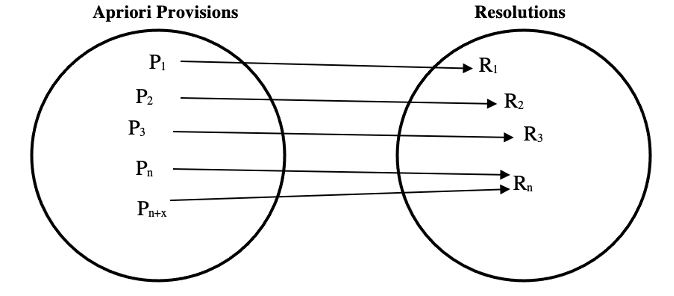
The mapping is surjective because multiple provisions may lead to the same resolution (ex. P(5-3) & P(4-2) map to the same element in R). The set of resolutions is generatively dependent on the set of provisions, so for every unique provision there is a resolution, it just may share that resolution with one or more different provisions. The argument could be made that R is larger than AP because although there exists a resolution for every provision, there also exist resolutions for provisions that have not yet been prompted. This leads to an interesting debate involving the philosophy of mathematics and mind, but that is beyond the scope of this analysis.
Human Handicap
Even though I believe that human agency is the most important factor in the success and sustainment of any large AI project, I also believe that it is the biggest handicap for these enterprises. This argument centers around anthropogenic proactive and reactive engagement with technology. In its raw form, technology scales fastest when its use is purely reactive – users seek it out – and slowest when its use is purely proactive – users arbitrarily encounter and use it. The exact degree of proactivity and reactivity of engagement is application specific, but this balance is what guides its aseptic adoption. In an enterprise environment, more variables are added to the equation. Sales, marketing, and other product-driven elements are layered on to accelerate growth, but the controls that guide and direct them are a product of the tech’s initial positioning relative to its intended user base.
This perspective is epitomized in the saying ‘build it and they will come,’ but I do not think this maxim is an entirely comprehensive projection of AI’s place in the world.
AI seems to be dichotomized between two applicative paths 1) information retrieval and discovery (chatGPT) 2) enhanced application engagement (email autocomplete) – with the former facilitating the latter. Even though the former may encompass a greater net utility for the average user, I think it will grow slower than the latter. This differential in productized usage will be a result of activation energy encompassed in it.
Regarding information retrieval, there is a viable and very effective alternative of it, leading to promotional efforts being less effective than on other mediums and the adoption of the new mechanisms resulting in a distinct dichotomization. Internet-native users will see a very frictionless conversion experience, whereas the new platforms will experience a good deal of resistance from the internet-adoptive segment of the population. I think the most successful way to overcome this friction is to build a forcing function (like Google did with IOS) but even still, old habits die hard.
Cornering applicative engagements with AI, they are already largely at work. The smoother scale-up in the impact that these measures will bring about is due to the already existent forcing function carrying their use. In being constantly encapsulated in the filter bubble of the tech sector, it is often hard to remember that field makes up a very small portion of the world.
I think the headline-grabbing growth that chatGPT may have misrepresented the nearer-term profusion of its industry. Despite the magical experience that LLM-based information retrieval and discovery modules provide, I am equally as bullish on the productivity impacts of more vertical-specific applications of generalizability over the coming years.
Innovation Saturation
Probably the most unconventional view that I gained from my work, but I think AI’s incorporation into many existing applications will cause the markets for such applications to move closer to a perfectly competitive positioning. Principally, if technologies influence on the world is just one long-tail optimization function, a closer relationship between the primitive layers of that function and the materialization of technology would lead to such technology nearing its most optimal form factor.
For example, this could emerge as an open-sourced LLM library curated around building optimal engagement with a text editor. The library is architected around the omnipresent functional components within the application and then trained to build out a custom framework on top of those components tailored to a specific user’s tendencies. In this scenario, the value of the optimization on top of the base product could outweigh any utility provided by the base itself. This would lead to every product that implements the framework providing the same NPV to the customer, that being the maximal.
This argument bakes in a lot of assumptions and ignores many of the realities of product development and deployment, as well as the relationship between generalizability and optimally; but, nonetheless, food for thought.
--
The moats in AI are not deep, but they are wide.